 Skip-the-line available
 Argentine Side vs Brazilian Side: Which Iguazu to Choose
The canonical comparison of the two parks that share the falls — what each one delivers, how long each takes, and how to combine them.
The question that defines every Iguazu itinerary is which side to visit. Iguazu Falls straddle the border between Argentina's Misiones province and Brazil's Parana state, and each country operates its own national park along its bank of the gorge. The two parks are independently ticketed, separately managed, and offer genuinely different experiences of the same set of cataracts. Roughly eighty per cent of the falls themselves sit inside Argentine territory, which is the reason the Argentine park gets the longer and more immersive set of walkways, while the Brazilian park's geographical position — looking across the gorge at the wall of water — gives it the panoramic vista that the Argentine side cannot match. This guide walks through what each side delivers, how long each takes, the realistic combinations, and how to decide if you only have time for one.
The Two Parks: A Quick Side-by-Side
The Argentine park, Parque Nacional Iguazu, was inscribed on the UNESCO World Heritage List in 1984. It is managed by Argentina's national parks administration, Administracion de Parques Nacionales (APN), through a concessioned operator. It is organised around three named circuits — Upper, Lower and Garganta del Diablo — connected by the small gas-powered Tren Ecologico de la Selva. The park covers approximately sixty-seven thousand hectares of subtropical Paranaense rainforest and the headline experience is immersion: you walk above, beside and almost into the water.
The Brazilian park, Parque Nacional do Iguacu, was inscribed in 1986. It is managed by Brazil's federal environment institute, ICMBio, through the concession operator Cataratas do Iguacu SA. It is structured around a single long cliffside trail, approximately one kilometre, that runs along the gorge facing the Argentine bank, ending at a catwalk that pushes out toward the Devil's Throat from the opposite side. The Brazilian park is larger in total area than the Argentine one — around one hundred and eighty-five thousand hectares — but the visitor portion is concentrated along the falls-facing trail and is much shorter to walk. The two parks share the falls but offer genuinely different visits.
What the Argentine Side Delivers
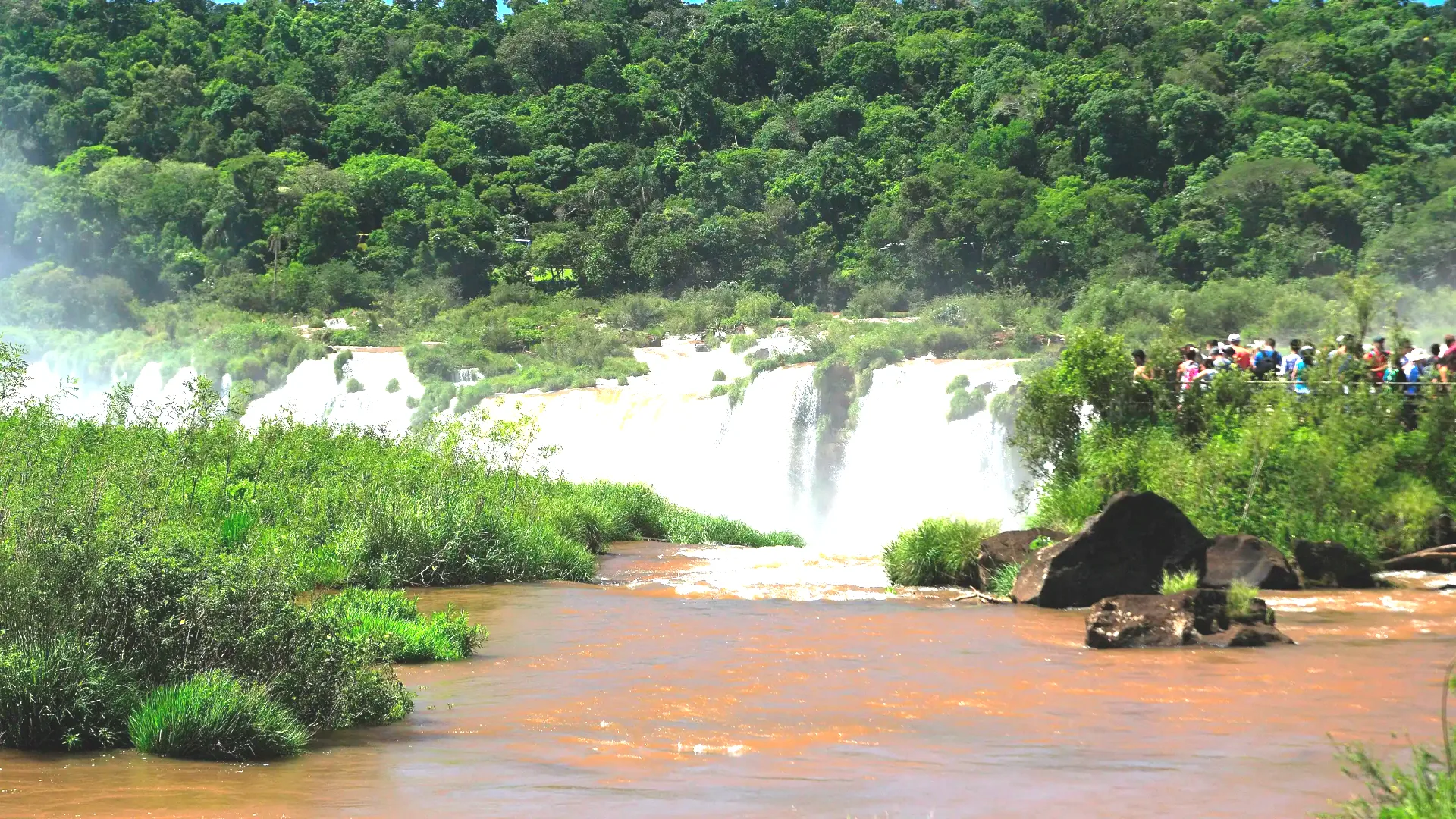
The Argentine side is the immersive experience. The Upper Circuit, an approximately 1,750-metre elevated boardwalk, traces the upper lip of the falls — you walk across the top of one cataract after another, looking down into each as the river drops away beneath your feet. The Lower Circuit descends to the base of the same set of cataracts, putting you at the foot of the spray cone. The Garganta del Diablo catwalk, accessed by the Ecological Train and a one-kilometre walk across the upper river, projects out over the chasm itself — an eighty-metre U-shaped drop into which multiple separate cataracts pour simultaneously. The sound is overwhelming, the spray column rises hundreds of metres.
Add-on experiences extend the day further. The Gran Aventura speedboat, operated by Iguazu Jungle, takes you under the falls themselves — a wet, exhilarating hour that is the single most memorable thing many visitors do at Iguazu. The Sendero Macuco jungle trail, a seven-kilometre return walk through Paranaense rainforest to a small private waterfall called Salto Arrechea, is the best chance of seeing larger wildlife. The Argentine side also offers a discount for a second consecutive day's admission if your ticket is stamped at the exit gate on day one, making a two-day Argentine visit cheaper than most visitors expect. Plan a full day, ideally two, for the Argentine park.
What the Brazilian Side Delivers
The Brazilian side is the panoramic experience. From its bank you face the long wall of cataracts on the Argentine side, with the entire amphitheatre visible in a single sweep — the photograph that appears on every postcard, every travel-magazine cover, every guidebook front page. The walkway runs along the cliff face for approximately one kilometre, with viewpoints opening at intervals onto the gorge below. The trail is paved, gently graded and accessible. The final catwalk pushes out from the Brazilian bank toward the Devil's Throat, putting you partway across the river facing the same chasm you may have looked into from the Argentine side, but from the opposite direction.
The Brazilian park's visit is shorter and more linear than the Argentine one. Four to five hours is enough to walk the trail, take photographs, ride the panoramic elevator to the upper viewing platform, and visit the small visitor centre. Optional add-ons include the Macuco Safari speedboat trip on the Brazilian side (operated independently of the Argentine Gran Aventura, with its own boarding area and route), helicopter rides over the falls (only available from the Brazilian side; the Argentine side does not permit helicopter overflights for conservation reasons), and the adjacent Parque das Aves bird park, which sits across the road from the park entrance and houses one of South America's largest collections of Atlantic Forest avifauna in walk-through aviaries.
Time Required: Half-Day, Full-Day, Both Days
The Argentine side rewards a full day. All three circuits — Upper, Lower and Garganta del Diablo — plus the Ecological Train transfers and a reasonable lunch break add up to a comfortable six-to-eight-hour visit at a moderate pace. Add the Gran Aventura speedboat and the day stretches closer to nine hours. Many visitors return for a half-day or full second day to walk their favourite circuit at a different time of day, attempt the Sendero Macuco trail, or simply revisit the Devil's Throat in different light. The Argentine park's second-day discount makes this affordable.
The Brazilian side is a four-to-five-hour visit, including the border crossing in both directions. The cliffside trail is short and there is no equivalent of the Argentine train transfers to add walking time. If you base in Puerto Iguazu, a Brazilian-side morning is the typical pattern: cross the border after breakfast, walk the trail, take optional add-ons like the helicopter or Parque das Aves, return mid-afternoon. Trying to combine both parks in a single twenty-four-hour window — Argentine morning, Brazilian afternoon, or vice versa — leaves you rushed at both and stuck at the border in between. Most itineraries allocate one full day to Argentina and one separate half-day to Brazil.
If You Can Only Do One: Choose Argentina
If your itinerary allows only one side, choose Argentina. The reasoning is consistent across travel writers, guidebooks and operator recommendations: the Argentine park contains roughly eighty per cent of the cataracts, all three vertical relationships to the water (above, beside, below), the Devil's Throat catwalk, and the under-the-falls speedboat. The Brazilian panorama is magnificent, but a single panorama — however spectacular — does not match a full day inside the falls. Many visitors who do only the Argentine side report not feeling they missed anything essential; visitors who do only the Brazilian side commonly wish they had also done the Argentine.
If you have two days, do Argentina first and Brazil second. The order matters: walking the Argentine circuits first gives you a sense of scale and of which individual cataracts you are looking at, which makes the Brazilian panorama far more legible on day two. You will be able to identify the Garganta del Diablo, the long ribbon of Salto San Martin, the staircase of smaller drops in between, and the islands that split the river. Doing Brazil first inverts that learning, and many visitors find the Brazilian panorama overwhelming without the Argentine context. The reverse — Brazil first, Argentina second — works, but most advice is Argentina first.
Frequently asked
Which side has more of the falls?
Roughly eighty per cent of the cataracts sit in Argentine territory. The Brazilian side faces the falls from across the gorge but contains a smaller proportion of the cataracts on its bank.
Can I do both sides in one day?
Technically yes, but it is not recommended. Combining both parks in a single twenty-four-hour window leaves you rushed at both and stuck at the border in between. A full Argentine day plus a separate Brazilian half-day is the standard pattern.
Do I need a separate ticket for each side?
Yes. The Argentine and Brazilian parks are independently managed and ticketed. There is no combined ticket. Each side's ticket is valid for one calendar day, though the Argentine side offers a discount for a consecutive second day.
Which side is better for photography?
Different photographs. The Argentine side is better for close-up, immersive shots — rainbow arcs, individual cataracts, the chasm itself. The Brazilian side is better for the wide panoramic shot of the entire amphitheatre. Serious photographers do both.
Is the Brazilian side worth a separate day if I only have two days total?
Yes, as a half-day. The panoramic view is genuinely different from anything the Argentine side offers, and four to five hours is enough including the border crossing. Save a full second day for re-walking the Argentine side or for the Macuco trail.
Can I take a helicopter over the falls?
Yes, but only from the Brazilian side. Argentina does not permit helicopter overflights of its national park for conservation reasons. The Brazilian operator runs short scenic flights from a heliport near the Brazilian park entrance.
Which side is more accessible for wheelchairs and strollers?
The Brazilian cliffside trail is paved, gently graded and well-suited to wheelchairs and strollers. The Argentine Upper Circuit and the Garganta del Diablo catwalk are also step-free and accessible. The Argentine Lower Circuit involves significant stairs and is not accessible.
Do I need a Brazilian visa for a day visit from Argentina?
Visa requirements depend on your nationality and change periodically. Many Western nationalities are visa-exempt for short Brazilian tourist visits, but some require advance authorisation. Check current requirements on the Brazilian government's consular site before travelling.
Which side is better for wildlife?
Both sides protect the same Atlantic Forest biome and host similar species. The Argentine Sendero Macuco trail and the Brazilian Parque das Aves bird park are the two strongest wildlife experiences in the region; both are worth adding to an itinerary.
If the Argentine Garganta catwalk is closed, can the Brazilian side substitute?
Partially. The Brazilian catwalk approaches the Devil's Throat from the opposite bank and gives you a comparable view of the chasm and its spray column, though not the directly-above perspective. If the Argentine catwalk is closed during your visit, prioritising the Brazilian side that day is the sensible substitution.